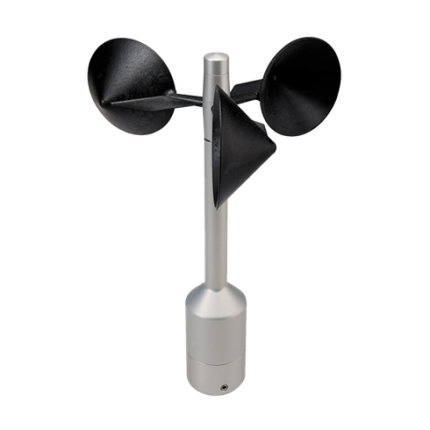
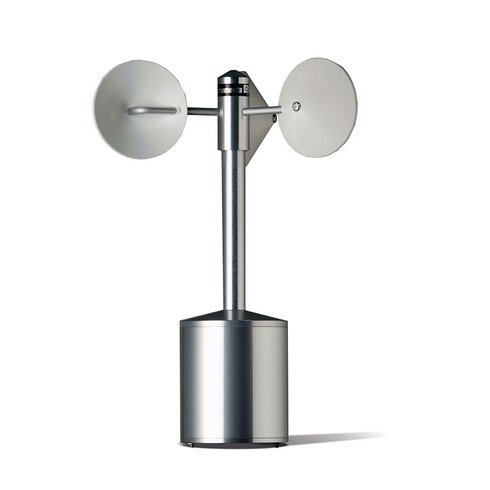
- Opto-electronic wind speed transmitter
- Classified according to IEC standard
- “Low Power”, high frequency output signal
- Range 0.2 … 75 m/s
- Resolution < 0.5 m/s
- Low power, pulse output only
- Consumes 1 mA while operating from the logger’s battery supply.
Measurement principle
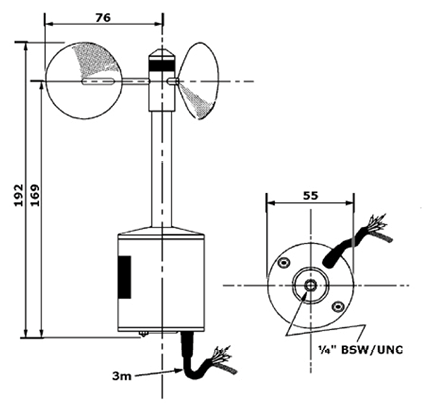
The low-inertia 3-cup rotor is set into rotation by the wind. The wheel is scanned optoelectronically and the measuring value is available at the output as a digital signal.
| Characteristics | |
|---|---|
| Measurement range | 0 … 75 m/s |
| Accuracy | ± 0.2 m/s (<10 m/s); ± 2% of reading (> 10m/s) |
| Resolution | 0.05 m/s |
| Non-Linearity | 0.4 % full-range output frequency (correction curve supplied) |
| Starting wind speed | 0.2 m/s |
| Survival wind speed | max. 75 m/s |
| Distance constant | 2.3 m ± 10 % |
| Ambient temperature | -30 … +70 °C |
| Transducer | Interruption of optical beam |
| Operating supply | 4.75 … 28 VDC (max 1.3 mA, average is typically less than 1 mA) |
| Electrical output | 0 … 750 Hz |
| Termination | cable length 3 m |
| Materials | Anodized aluminium, weather-resisting plastics |
| Weight Anemometer | 0.5 kg (Gross weight for shipping: 1 kg) |
| Recalibration | recommended interval every 24 months |
| Manufacturer | Vector Instruments / UK (A100LM) |